


Technical Benchmark: Cryo-EM analysis of extremely challenging RNA-protein complexes, with Chinese teams leading structural biology research in plant RNA interference
I. Research Background: The "Double-Edged Sword" of Plant RNA Interference
In the microscopic world, plants and viruses have been at war for hundreds of millions of years. When viruses invade plant cells and release their RNA genomes, plants don't stand defenseless—they've evolved a sophisticated "RNA defense system," where small interfering RNAs (siRNAs) act as "molecular missiles," precisely identifying and destroying viral RNA.
In model plants like Arabidopsis thaliana, the complex formed by DICER-LIKE 4 (DCL4) and its cofactor DRB4 serves as the core "factory" producing 21-nucleotide (21-nt) siRNAs. These siRNAs function like custom-designed "molecular keys" that specifically recognize viral RNA sequences and guide degradation machinery to precisely destroy invaders. For two decades, scientists knew that DCL4-DRB4 has a unique preference for long RNA substrates, but the molecular mechanism remained a mystery.
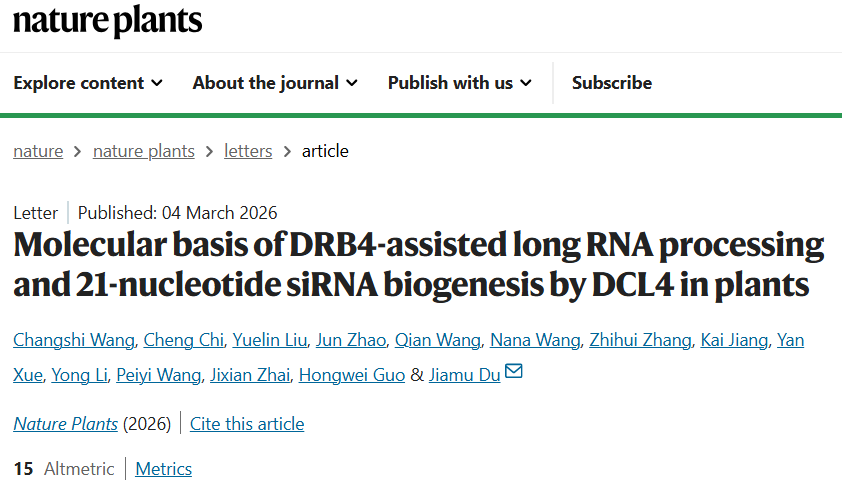
In February 2026, a team led by Prof. Jiamu Du from Southern University of Science and Technology published a landmark study in Nature Plants, revealing high-resolution structures of the DCL4-RNA complex in dicing-competent conformation and the DCL4-DRB4-RNA complex in pre-dicing conformation. This research, led by Chinese scientists, not only fills critical knowledge gaps in plant RNA interference but also opens new strategies for crop protection based on structural design.
II. Breakthrough Discoveries: Dissecting the Plant's "RNA Tailor" Toolkit
1. The Precise "Molecular Ruler": How 21-nt siRNA is Accurately Measured
The research team first captured the structure of the DCL4-RNA complex in dicing-competent conformation at 3.15Å resolution. Remarkably, DCL4 functions like a precise tailor, using the fixed distance between its PAZ domain and RNase III domains to measure exactly 21 nucleotides along the RNA substrate.
Structural analysis revealed: DCL4's Tyr1041 in the PAZ domain stacks with the 5'-G1 base of the guide strand RNA, serving as the starting point for measurement; meanwhile, the active site of the RNase IIIb domain precisely cleaves the phosphodiester bond between G21 and C22 of the guide strand, ensuring strict production of 21-nt siRNAs. This "start-stop" molecular measurement mechanism explains why DCL4-produced siRNAs have highly consistent lengths—a critical feature for effective loading into AGO proteins and functional activity.
2. Unique "Long RNA Preference": Key Adaptation for Antiviral Defense

Unlike mammalian Dicer, DCL4 exhibits a distinct length preference—it efficiently processes long double-stranded RNA (dsRNA) of 50-500 bp rather than short fragments. This study reveals the molecular basis for this phenomenon for the first time:
-
Critical Role of LinkerRBDs Region: A unique long loop region in DCL4 (LinkerRBDs) wraps around the RNase III domains, positioning the dsRBD2 domain (double-stranded RNA binding domain 2) at a distal position on the RNA substrate (approximately 50 bp from the 5' end). This means DCL4 requires at least 50 bp of RNA for complete substrate binding, explaining its long RNA preference at the structural level.
-
DRB4's Collaborative Positioning: In the pre-dicing conformation structure of DCL4-DRB4-RNA complex, DRB4 interacts with DCL4's dsRBD2 via its C-terminal domain (DRB4CTD), further directing DRB4's two N-terminal dsRBD domains to even more distal positions on the RNA. This "hand-in-hand" collaboration dramatically extends the complex's capacity to capture long RNA.
3. "Tolerant Philosophy" of Substrate Recognition: Adapting to Diverse Viral Invasions
The research uncovered DCL4's unique strategy in substrate recognition—low selectivity for critical terminal features:
-
5' End Recognition: DCL4 requires only a phosphate group at the 5' end of the guide strand, with no selectivity for the first base type (Tyr1041 can stack with any base), enabling it to process RNA from various viral sources.
-
3' End Tolerance: DCL4 tolerates blunt ends, 1-nt, or 2-nt overhangs at the 3' end of the complementary strand, unlike DCL3 which strictly prefers 1-nt overhangs. Its PAZ domain lacks a complete aromatic cap structure, preventing specific recognition of 3' overhangs like DCL3.
This "tolerant" substrate recognition strategy allows the DCL4-DRB4 complex to handle diverse viral RNA substrates and also provides the foundation for continuous processing to produce phased siRNAs (phasiRNAs)—after the first cut produces a 2-nt 3' overhang, this overhang becomes the ideal substrate feature for the next round of cutting, enabling continuous "assembly line" siRNA production.
4. From Capture to Cutting: The Dynamic Cycle of RNA Processing
By comparing DCL4 structures in pre-dicing and dicing-competent conformations, the research team proposed a dynamic model for DCL4-DRB4 processing of long RNA:
- Capture Phase: DRB4 helps DCL4 capture long dsRNA, with DCL4's helicase domain acting like a "motor" moving along the RNA
- Positioning Phase: When the RNA end reaches the PAZ domain, movement pauses and RNA bends at position C29
- Cutting Phase: RNA further bends to position C11, approaching the RNase III active sites for precise cleavage
- Cycling Phase: After 21-nt siRNA release, the helicase domain "pumps" the remaining RNA to the next cleavage site
This "grab-bend-cut-move" cycle perfectly explains how DCL4 continuously produces equally-spaced 21-nt siRNAs on long RNA, forming phasiRNA arrays.
III. Industry Impact: From Basic Research to Applications
1. New Targets for Antiviral Crop Breeding
Globally, plant viruses cause over $30 billion in annual agricultural losses. Traditional antiviral strategies often rely on single R genes, which viruses can quickly overcome. The DCL4-DRB4 pathway, as a broad-spectrum antiviral mechanism, offers new breeding targets:
- Enhancing DCL4 Expression: Using gene editing to increase DCL4 activity in crops, enhancing resistance to multiple viruses
- Optimizing LinkerRBDs: Designing DCL4 variants with extended RNA preference to improve processing efficiency of long viral genomes
- DRB4 Collaborative Engineering: Modifying the DCL4-DRB4 interaction interface to improve complex stability
2. Molecular Guide for RNA Pesticide Design
RNA interference-based pesticides (such as dsRNA sprays) are considered next-generation green pesticides due to their high specificity and environmental friendliness. However, high costs and poor stability are major bottlenecks. This research provides critical guidance for optimizing plant RNA pesticides:
- Length Optimization: Designing 50-100 bp dsRNA fragments matching DCL4-DRB4 substrate preferences to improve processing efficiency
- Terminal Modifications: Adding phosphate groups to the 5' end and designing 2-nt overhangs at the 3' end to enhance DCL4 recognition
- Delivery Systems: dsRNA packaged in nanoparticles should expose sufficiently long terminal regions for DCL4-DRB4 capture
DCL4-DRB4's "continuous cutting" capability makes it an ideal RNA processing tool for synthetic biology:
- Programmable RNA Cutters: Fusing DCL4 cutting domains with artificial RNA recognition modules to create customized RNA processors
- Biosensors: Designing DCL4 variants responsive to specific molecules that cleave reporter RNA to produce detectable signals
- Gene Circuit Regulation: Utilizing DCL4 cutting properties to build RNA cascade amplification systems, enhancing sensitivity of synthetic gene circuits
4. China's Leadership in Structural Plant Biology
This study was led by Prof. Jiamu Du's team at Southern University of Science and Technology, in collaboration with Shandong Agricultural University, Peking University Institute of Advanced Agricultural Sciences, and other institutions. It marks China's leading position in structural biology of plant RNA interference. The technical approach (cryo-EM analysis of RNA-protein complexes) sets a new standard for similar research, with methodological implications across plant molecular biology.
IV. Future Outlook: The Next Stop for RNA Defense
-
DCL4-DRB4-AGO Functional Module Analysis
The next step is to resolve structures of DCL4-DRB4 with AGO1 (siRNA effector), revealing the complete process from siRNA generation to loading. -
Research on Viral Counter-Defense Mechanisms
Many plant viruses encode VSRs (viral suppressors of RNA silencing) targeting DCL4. Analyzing these interactions will reveal molecular details of the host-pathogen arms race. -
Diversity Mining of Crop DCL4s
DCL4s in major crops like rice, wheat, and maize may have functional specializations. Systematic comparisons will guide precise crop protection strategies. -
Artificial DCL4 Design
Structure-based simulations could design DCL4 variants with custom cutting lengths (e.g., 22-nt or 24-nt), expanding the RNA interference toolkit.
V. Conclusion: Small Molecules, Great Defense
In the microscopic world of plant cells, the DCL4-DRB4 complex functions like a silent guardian, "tailoring" RNA with nanometer precision to build molecular defenses against viral invasion. This research, led by Chinese scientists, not only reveals the working principles of this sophisticated molecular machine but also opens the door to rationally designing plant immune systems.
From fields to laboratories, from basic discovery to industry application, RNA interference technology is quietly transforming agriculture's future. As scientists learn to "read" plants' defense codes, human collaboration with nature will enter a new era—not conquering nature, but dancing with it. This may be the most profound insight we gain from the DCL4-DRB4 "RNA scissors master."
