


Repurposing Toxins as Signals: How the Kongming System Achieves Ultrasensitive Immunity Through Filament-Mediated Allostery
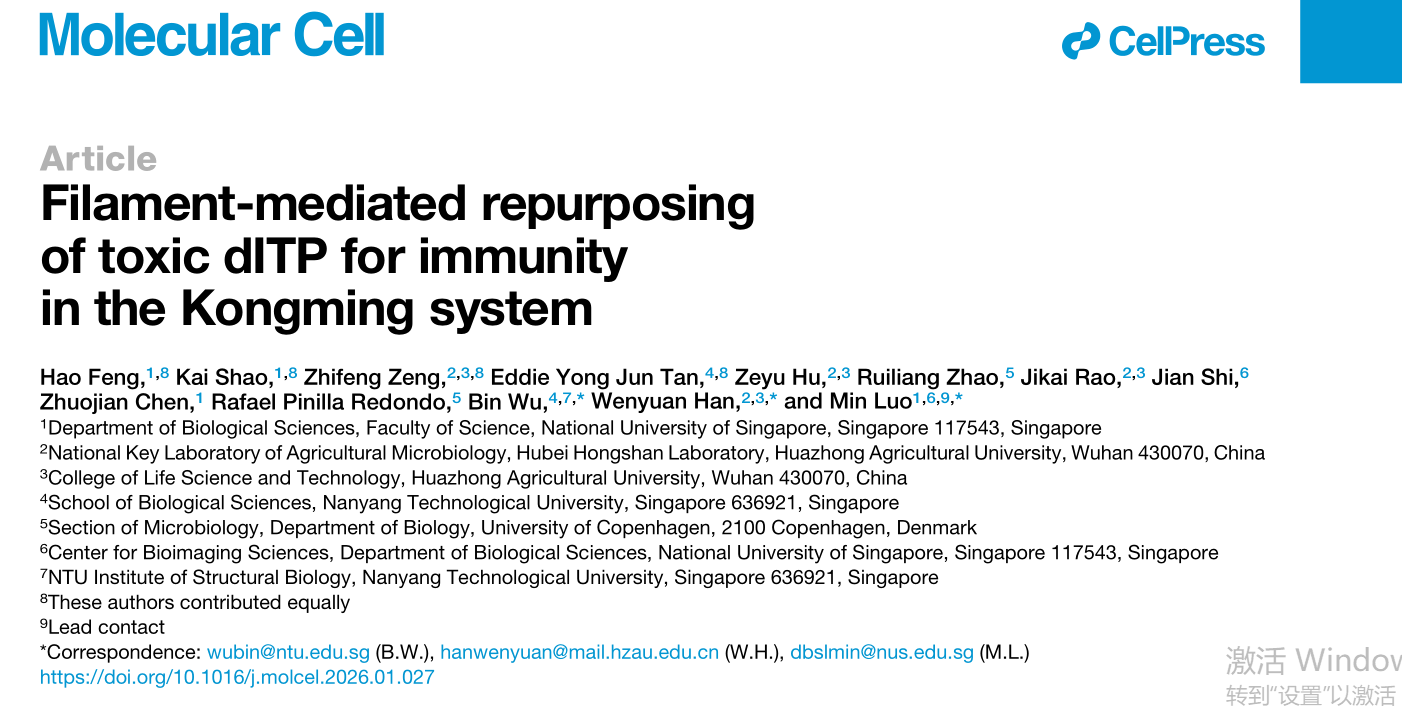
Filament Architecture and Allosteric Magic: How Bacteria Transform "Poison" into Immune Weapons
In the evolutionary battlefield of life, the war between bacteria and bacteriophages has raged for billions of years. This microscopic arms race has spawned astonishing defense mechanisms, from the well-known CRISPR system to recently discovered CBASS and Thoeris systems. Bacteria's immune toolkit is far richer than we ever imagined. However, a groundbreaking study recently published in Molecular Cell reveals an unprecedented defense strategy—bacteria not only repurpose toxic metabolites as immune signals but also achieve ultrasensitive detection through an elegant filament architecture. This is the Kongming system, named after the Three Kingdoms period military strategist, representing the "immune wisdom" of bacteria.
From "Poison" to "Messenger": The Remarkable Transformation of dITP
In the cellular world, deoxyinosine triphosphate (dITP) has long been regarded as a dangerous molecule. This non-canonical nucleotide can cause mutations during DNA synthesis, so cells have evolved multiple clearance mechanisms, including "housekeeping" enzymes like HAM1, MutT, and NUDT16 that maintain dITP at extremely low levels. The Kongming system, however, turns this logic on its head, transforming this toxin into the trigger for an immune response.
The research team discovered that upon phage infection, the KomA protein in the Kongming system deaminates dATP to produce dITP as an infection alarm. More surprisingly, the effector complex KomBC (composed of KomB and KomC subunits) doesn't degrade this signal but captures and amplifies it, triggering NAD+ hydrolysis that ultimately leads to suicidal cell death, preventing phage propagation.
"It's like converting a bomb into an alarm system," explains the lead researcher. "Bacteria aren't simply eliminating toxins—they're weaponizing them for communal defense."
Preassembled Filament Structure: The Immune "Antenna" Awaiting Signals
Traditional bacterial immune systems (like CBASS and Thoeris) typically assemble into active structures only after signal molecule binding. The Kongming system employs a radically different strategy: KomBC preassembles into filamentous polymers, standing ready like antennas awaiting dITP signals. Cryo-EM structures reveal these filaments are composed of repeating octameric units, each containing four KomB and four KomC molecules arranged in an open C2-symmetric conformation.
The KomB subunit evolved from the HAM1 pyrophosphatase family but has lost catalytic activity, instead developing an ultra-high-affinity dITP binding pocket (Kd ~2.2 nM)—100,000 times stronger than its ancestral HAM1 enzymes. KomC functions as a Sir2-type NAD+ hydrolase, commonly found in bacterial immune systems.
"This preassembled architecture represents a major shift in bacterial immune strategy," comments an expert not involved in the study. "It enables millisecond-level response to infection rather than the minute-scale process of waiting for protein assembly."
Substoichiometric Activation: The Science of "Less is More"
The most astonishing discovery is how the Kongming system achieves "less is more" signal amplification. Experiments show that just one dITP molecule per ten KomBC complexes can trigger 50% maximum NADase activity, with a 1:2 ratio achieving full activation. This means a faint dITP signal can propagate cooperatively through the filament structure, activating enzyme activity far beyond the number of signal molecules.
Structural biology reveals the mechanism: dITP binding to KomB induces local conformational changes that transmit through precisely engineered interfaces to adjacent KomC NADase domains. This activation then propagates along the filament through conserved interlayer interfaces, enabling cooperative allosteric effects. Cryo-EM structures show that dITP binding transforms the filament from a relaxed C2-symmetric to a compact D2-symmetric conformation, increasing helical twist by 10 degrees and compressing layer spacing.
"It's like a domino effect," explains the paper's first author. "When the first domino (dITP binding) falls, the entire array (filament) activates."
Evolutionary Innovation: From Housekeeping Enzyme to Immune Sensor
Bioinformatic analysis shows that the Kongming system is not a rare anomaly but is widely distributed across bacterial phyla including Pseudomonadota, Bacillota, and Actinomycetota, often located within defense islands, plasmids, or prophages. Sequence comparisons reveal how KomB evolved from HAM1: key changes include the introduction of an FQWD motif (Phe140-Gln141-Trp144-Asp143) that forms an aromatic cage specifically recognizing the hypoxanthine base; His65 replaces the catalytic aspartate, eliminating hydrolytic activity and transforming the binding pocket into a "trap" rather than a "processor."
Similarly, KomC has evolved a unique tetrameric organization unlike other Sir2-family effectors through interface remodeling. These co-evolved interface residues are highly conserved across over 1,000 Kongming homologs but absent in non-immune-related HAM1 and Sir2 proteins, indicating functional specialization.

Industry Implications: From Basic Science to Applications
The discovery of the Kongming system offers inspiration across multiple fields:
Biosensor Design: Its ultrasensitivity (picomolar dITP detection) provides a blueprint for next-generation diagnostic tools. Engineered filament structures could be reprogrammed to detect environmental pollutants, pathogen markers, or disease metabolites.
Synthetic Biology: The substoichiometric activation principle could design resource-efficient biological circuits that trigger strong responses at low signal levels, reducing metabolic burden on cells.
Antibacterial Strategies: Understanding phage-bacteria warfare could help develop "phage therapy enhancers" that inhibit Kongming and other defense systems, improving phage treatment efficacy.
Drug Discovery: The filament-mediated allosteric propagation mechanism might inspire strategies for treating protein aggregation diseases like Alzheimer's and Parkinson's.
A biotech startup has already begun exploring this technology. "We're engineering fusions of KomB's dITP-sensing domain with reporter proteins to create intracellular metabolite sensors," reveals the company's CSO. "This 'preassembled + cooperative amplification' architecture responds faster and more sensitively than existing systems."
Future Outlook: The Bacterial Immune Treasury is Not Fully Explored
With advances in metagenomics, scientists predict bacterial immune system diversity far exceeds current knowledge. The discovery of the Kongming system suggests that even "metabolic waste" might be repurposed in evolution as precisely regulated signaling molecules.
"We're reevaluating the significance of 'metabolic noise' in cells," reflects a field expert. "Many molecules considered byproducts may be components of undiscovered signaling systems."
The research team plans to further explore:
- The ecological role of the Kongming system in natural environments
- Dynamic regulation mechanisms of filament assembly
- Cross-talk with other bacterial immune systems
- Engineering Kongming components for biocomputing
Conclusion: Small Bacteria, Big Wisdom
The Kongming system is aptly named after Zhuge Liang (courtesy name Kongming), the Three Kingdoms period military strategist renowned for wisdom and strategic foresight. Bacteria demonstrate astonishing evolutionary wisdom by transforming toxins into signals, preassembling defense structures, and achieving cooperative amplification.
In the biotechnology era, understanding these microscopic strategies not only expands fundamental science but also provides new tools for addressing human health and environmental challenges. As one senior researcher notes: "When we design smarter systems, perhaps we should learn from these 3-billion-year-old evolutionary masters."
In this never-ending arms race of life, bacteria once again prove that sometimes the greatest innovation isn't inventing new weapons but repurposing existing resources in unexpected ways to meet challenges. The Kongming system not only rewrites the textbook on bacterial immunity but also points to new pathways for human technological advancement—finding opportunity in constraints, value in toxins. This may be the most profound scientific insight of all.
