


AHCY-Adenosine Complex: A Novel Prognostic Biomarker and Precision Therapeutic Target in Cancer
In a landmark study published in Cell Research, a Sino-US collaborative team led by Sun Yat-sen University Cancer Center has cracked a long-standing mystery in cancer metabolism, unveiling a revolutionary mechanism by which the methionine cycle directly controls gene expression independent of its classical methyl donor function. The research reveals that the enzyme AHCY (S-adenosylhomocysteine hydrolase) teams up with its own metabolite, adenosine, to form a complex that acts as a molecular "dimmer switch" for RNA epigenetic marks, ultimately fueling tumor growth through lipid metabolism reprogramming. This discovery rewrites textbook concepts and opens up fresh diagnostic and therapeutic avenues for multiple cancer types.
The Scientific Puzzle: Why AHCY Matters Beyond Methylation
Cancer cells are notorious for hijacking metabolic pathways to sustain their relentless proliferation. The methionine cycle has long been a focus of interest because it produces S-adenosylmethionine (SAM), the universal methyl donor for DNA, histone, and RNA modifications. Clinically, methionine restriction shows anticancer effects, but the underlying mechanisms remain incompletely understood. Paradoxically, clinical data from colorectal and ovarian cancer patients show that AHCY expression correlates more strongly with mRNA m6A levels than MAT2A (the SAM-synthesizing enzyme), and SAM supplementation fails to fully restore m6A loss upon methionine deprivation. These clues suggested a SAM-independent pathway linking methionine metabolism to epigenetic regulation.
Adenosine, a byproduct of AHCY enzymatic activity, is traditionally viewed as a signaling molecule that acts on cell-surface receptors. However, the research team hypothesized that intracellular adenosine might directly bind AHCY to create a functional complex with epigenetic regulatory activity. If proven, this would establish a new paradigm of "metabolite-enzyme complexes" as direct modulators of gene expression.
Three Revolutionary Discoveries
Discovery 1: Adenosine-AHCY Complex Bypasses SAM to Control m6A Modifications
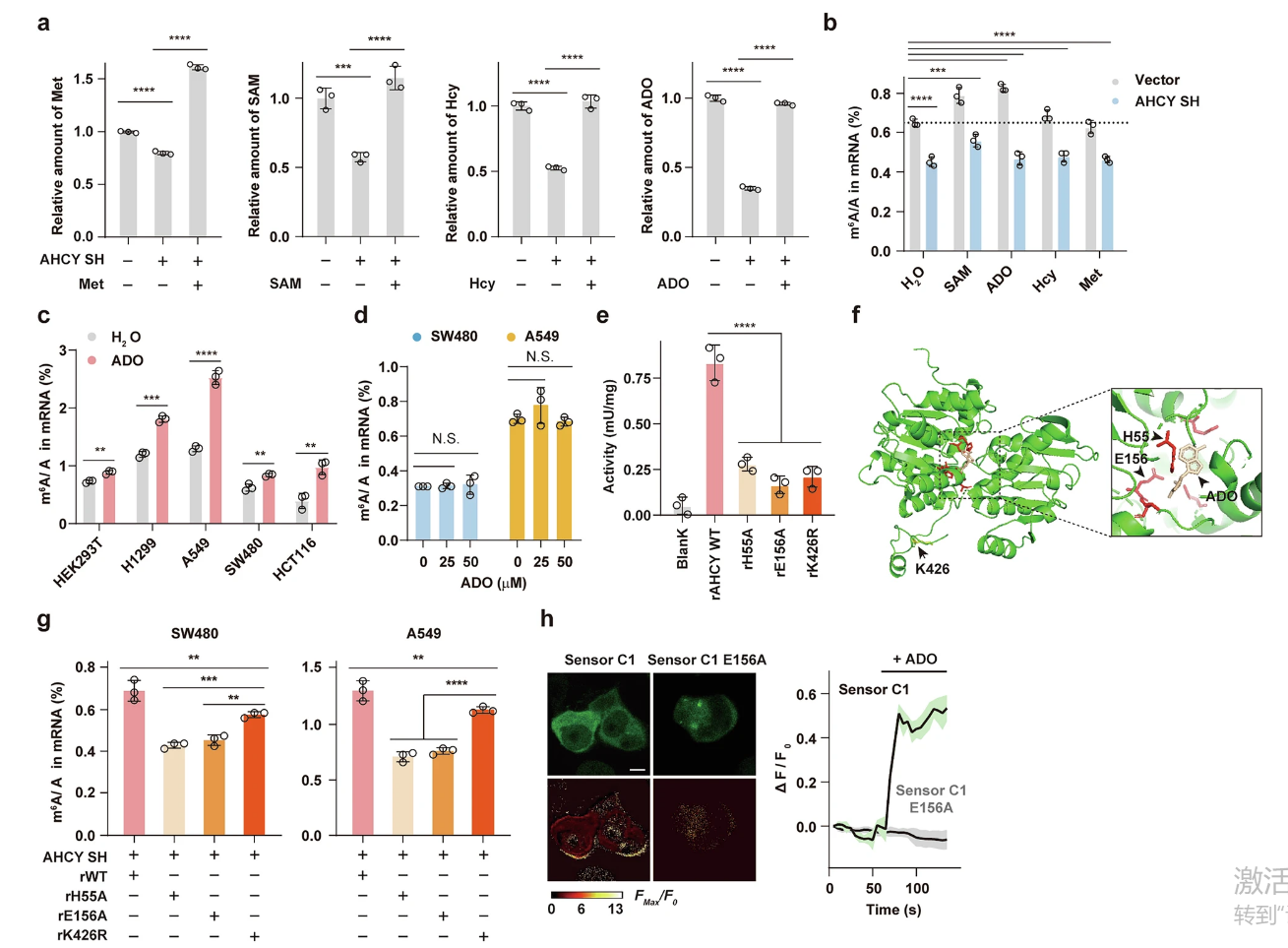
Using genome-wide CRISPR screening of 1,773 metabolic enzymes under SAM-replete conditions, AHCY emerged as a top hit for m6A regulation. Depleting AHCY reduced mRNA m6A/A ratios by 30-40% across multiple cancer cell lines, while MAT2A knockdown had minimal effect. Strikingly, only adenosine supplementation could dose-dependently rescue m6A levels, whereas SAM, SAH, or homocysteine could not. This provides the first molecular evidence that the AHCY-adenosine complex constitutes a SAM-independent epigenetic regulator.
Discovery 2: AHCY Dimers Act as "Molecular Handcuffs" on the FTO Demethylase
The team mapped the entire signaling cascade:
-
Adenosine binding induces AHCY dimerization, converting monomeric AHCY into dimers with >10-fold increased stability
-
AHCY dimers physically occlude FTO (fat mass and obesity-associated protein, the primary m6A demethylase) by engaging its Q86 residue
-
This blocks FTO's access to specific RNA motifs (VWDRACH, especially GADRACH) that control lipid metabolism genes
-
Result: m6A marks on ACACA (acetyl-CoA carboxylase) and SCD1 (stearoyl-CoA desaturase) mRNAs are protected from erasure, boosting their expression
This mechanism explains why AHCY affects m6A in a gene-selective manner rather than globally, a key distinction from SAM-dependent pathways.
The AHCY-Adenosine-FTO Axis Drives Lipid Synthesis and Tumorigenesis
-
Functional impact: m6A stabilization increases ACACA and SCD1 protein levels by 2-3 fold, activating de novo fatty acid synthesis
-
Isotope tracing: U-¹³C-glucose labeling shows AHCY knockout reduces palmitate synthesis by 60% and monounsaturated fatty acids by 50%
-
Phenotypic consequences: Lipid droplet formation drops 60%, cell proliferation slows by 50%, and tumor sphere formation capacity plummets
-
In vivo validation: In AOM/DSS-induced colorectal cancer models, intestinal-specific Ahcy deletion reduces tumor burden by 60% and tumor number by 55%
Clinical Translation: From Bench to Bedside
Prognostic Biomarker Value Analysis of 101 colorectal and 151 lung cancer specimens reveals:
-
AHCY is overexpressed in 78% of tumors vs 22% of adjacent normal tissue
-
High AHCY correlates with high ACC1/SCD1 expression (Spearman's r=0.68, p<0.001)
-
Survival impact: Patients with high AHCY have 35% lower 5-year overall survival (HR=1.85, p<0.01)
-
Synergistic stratification: Combining AHCY levels with an adenosine-synthesis gene signature identifies ultra-high-risk patients with 18-month shorter median survival
Therapeutic Targeting Proof-of-Concept The team developed peptide AA#7, a cell-penetrating peptide that disrupts AHCY dimerization:
-
In vitro: Reduces m6A levels by 30%, decreases lipid droplets by 50%, and inhibits proliferation across 6 cancer cell lines
-
In vivo: In patient-derived xenograft (PDX) models, AA#7 treatment suppresses tumor growth by 65% without affecting normal tissue methionine metabolism
-
Precision advantage: Because AHCY enzymatic activity is preserved, this approach avoids systemic toxicity associated with conventional AHCY inhibitors
Therapeutic Window: The AHCY-adenosine axis is particularly active in tumors with high metabolic stress, creating a synthetic lethal vulnerability that can be exploited without harming normal cells.
Broader Implications and Next Steps
Paradigm Shift: This work establishes that metabolic enzymes can moonlight as direct epigenetic regulators independent of their catalytic function. Adenosine acts not just as a metabolite but as an allosteric ligand that remodels AHCY's function, expanding the "metabolite signaling" concept.
Technological Toolkit: The study provides:
-
AHCY-based adenosine sensor for real-time imaging of metabolite-enzyme dynamics
-
Chemically inducible proximity system to manipulate complex formation with spatiotemporal precision
-
Peptide inhibitors targeting protein-protein interfaces as a new drug modality
Future Directions:
-
Clinical trials: The team aims to advance AA#7 or small-molecule AHCY dimer inhibitors to Phase I trials within 2-3 years
-
Combination therapies: Targeting AHCY may synergize with immunotherapy by altering tumor lipid microenvironment
-
Non-oncology applications: The AHCY-adenosine axis may play roles in metabolic syndrome, neurodegeneration, and embryonic development
-
Diagnostic development: AHCY IHC staining could become a routine pathology test for risk stratification
