


Beyond Linear mRNA: How Scarless Circular mRNA is Redefining the Efficacy Horizon of Next-Gen CAR-T Cells

Chimeric Antigen Receptor T-cell (CAR-T) therapy, a revolutionary "living drug," has achieved remarkable success in treating hematological malignancies. However, its clinical application is still hindered by significant challenges, with transience and safety being two core bottlenecks. While conventional viral vector-based CAR-T cells offer long-term persistence, they carry the risk of insertional mutagenesis. Conversely, non-viral approaches using linear mRNA (mRNA) are safer but suffer from rapid mRNA degradation within cells, leading to short-lived CAR expression and limited efficacy.
Recently, a landmark study published in Signal Transduction and Targeted Therapy offers an innovative solution to this dilemma. The research team developed a novel circularization strategy named Hi-Scarless-PIE, successfully synthesizing **scarless circular mRNA **(cmRNA), and applied it to the generation of CAR-T cells. The results demonstrate that these cmCAR-T cells exhibit not only **significantly enhanced persistence and potent cytotoxicity compared to linear mRNA-based CAR-T **(mCAR-T) but also achieve superior tumor clearance and a higher safety profile in vivo, paving a new path for the development of next-generation CAR-T therapies.
Breakthrough Technology: Hi-Scarless-PIE Enables Precise, Scarless Circularization
Circular RNA (circRNA), owing to its unique covalently closed loop structure, is inherently resistant to exonuclease degradation, theoretically enabling more durable protein expression than linear mRNA. However, traditional circularization methods (e.g., the classical PIE strategy) leave behind extraneous amino acid sequences (i.e., "scars") at the ligation junction, which can potentially interfere with the function and stability of the encoded protein, such as a CAR.
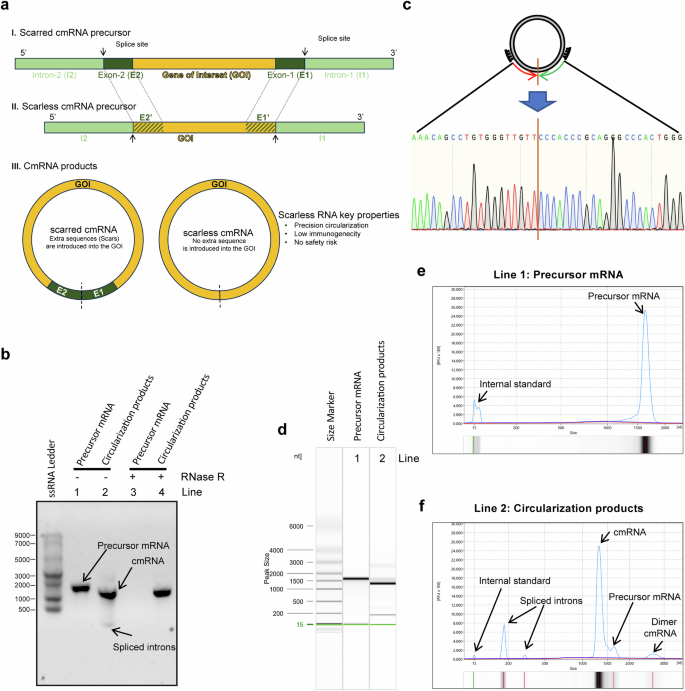
The core innovation of this study lies in the development of the **Hi-Scarless-PIE **(High-efficiency Scarless Permuted Intron Exon) technology. By engineering a self-splicing intron, this strategy precisely removes all non-templated sequences post-circularization, generating "scarless" cmRNA with a perfectly accurate junction sequence. The researchers confirmed through RNase R resistance assays, Sanger sequencing, and capillary electrophoresis that this method efficiently (>90%) and accurately produces the target cmRNA, laying a solid foundation for subsequent functional studies.
In Vitro Validation: cmCAR-T Cells Exhibit Durable and Potent Cytotoxicity
The team constructed both cmCAR-T and mCAR-T cells targeting CD19 (for B-cell malignancies) and GPRC5D (for multiple myeloma) and conducted systematic in vitro functional assessments.
Results showed that on day 1 post-transfection, both cmCAR-T and mCAR-T cells efficiently and specifically lysed their corresponding antigen-positive tumor cells (e.g., NALM-6, Raji or MM.1S, RPMI-8226), while showing no effect on negative control cells (K562), confirming their target specificity.
The critical difference emerged in persistence. By day 4 post-transfection, the cytotoxicity of mCAR-T cells had significantly waned—their killing efficiency against NALM-6 cells dropped to 40-60%, and they completely lost measurable cytotoxicity against Raji cells. In stark contrast, cmCAR-T cells maintained near-complete tumor cell lysis throughout the observation period. This clearly demonstrates that scarless cmRNA enables long-term, stable CAR protein expression, endowing T cells with durable anti-tumor activity.
Furthermore, cytokine release analysis revealed that activated cmCAR-T cells secreted high levels of IFN-γ, TNF-α, and IL-2, indicating an immune activation status comparable to mCAR-T cells and further validating their functional integrity.
In Vivo Efficacy: cmCAR-T Achieves More Complete Tumor Clearance
To evaluate its therapeutic potential in vivo, the team established mouse tumor models. Mice treated with cmCAR-T cells exhibited significantly more pronounced and sustained suppression of tumor growth. Compared to mice receiving mCAR-T therapy, the cmCAR-T group showed lower tumor burden and longer survival. These data robustly confirm that cmRNA-driven CAR-T cells maintain superior anti-tumor efficacy even within the complex in vivo microenvironment.
Safety Advantage: Mitigating Genomic Integration Risks
Beyond its outstanding efficacy, the safety profile of this technology is another major highlight. Since cmRNA functions entirely within the cytoplasm and does not enter the nucleus, it fundamentally eliminates the risk of random genomic integration associated with viral vectors. Additionally, its transient nature (albeit much more persistent than linear mRNA) provides a safety window for managing potential side effects like cytokine release syndrome. This combination of high efficacy, durability, and safety makes cmCAR-T therapy highly attractive for clinical translation.
Conclusion and Outlook
This study successfully integrates cutting-edge RNA circularization technology with the established CAR-T platform to create a next-generation cell therapy with markedly enhanced performance. The Hi-Scarless-PIE technology not only solves the "scar" problem of traditional circularized mRNA but also fully leverages the stability advantages of circRNA. cmCAR-T cells have demonstrated superior persistence, efficacy, and safety over existing mCAR-T in both in vitro and in vivo settings, providing a powerful technological platform for treating relapsed/refractory hematologic cancers and potentially expanding into solid tumors in the future.
As the field of RNA therapeutics advances at a rapid pace, this scarless circular mRNA-based strategy is poised to become a core engine for next-generation cell and gene therapy products, offering new hope to many patients.
