


Precision “Sniper” for Pathogenic RNA! The dCasCMA Platform Ushers in a New Era of Programmable RNA Degradation
Introduction: The Promise and Peril of RNA-Targeted Therapy
In the post-genomic era, scientists have discovered that over 70% of the human genome is transcribed into RNA, yet only about 1.5% encodes proteins. This vast “non-coding RNA universe,” along with the RNA of various pathogenic viruses, represents an unprecedented treasure trove of therapeutic targets. Thus, developing technologies capable of precisely, efficiently, and safely degrading specific RNAs has become the holy grail of biomedicine.
Currently, RNA interference (RNAi) and antisense oligonucleotides (ASOs) are the mainstream RNA-targeting technologies. However, they each have limitations: RNAi can suffer from off-target effects due to short sequence matches, while ASOs face challenges with delivery efficiency and stability. The CRISPR-Cas13 system, hailed as an “RNA scissors,” offers high specificity but carries the risk of cytotoxicity due to its indiscriminate “bystander cleavage” activity.
To address these challenges, a team led by Prof. Shu-Lin Liu from Nankai University has published a breakthrough study in Nature Communications. They ingeniously bypassed Cas13’s cleavage activity and instead leveraged its precise “GPS” targeting function, linking it to the cell’s own “recycling plant”—the **Chaperone-Mediated Autophagy **(CMA) pathway—to develop a novel programmable RNA degradation platform named dCasCMA.
A Masterstroke of Repurposing: The Elegant Marriage of dCas13d and CMA
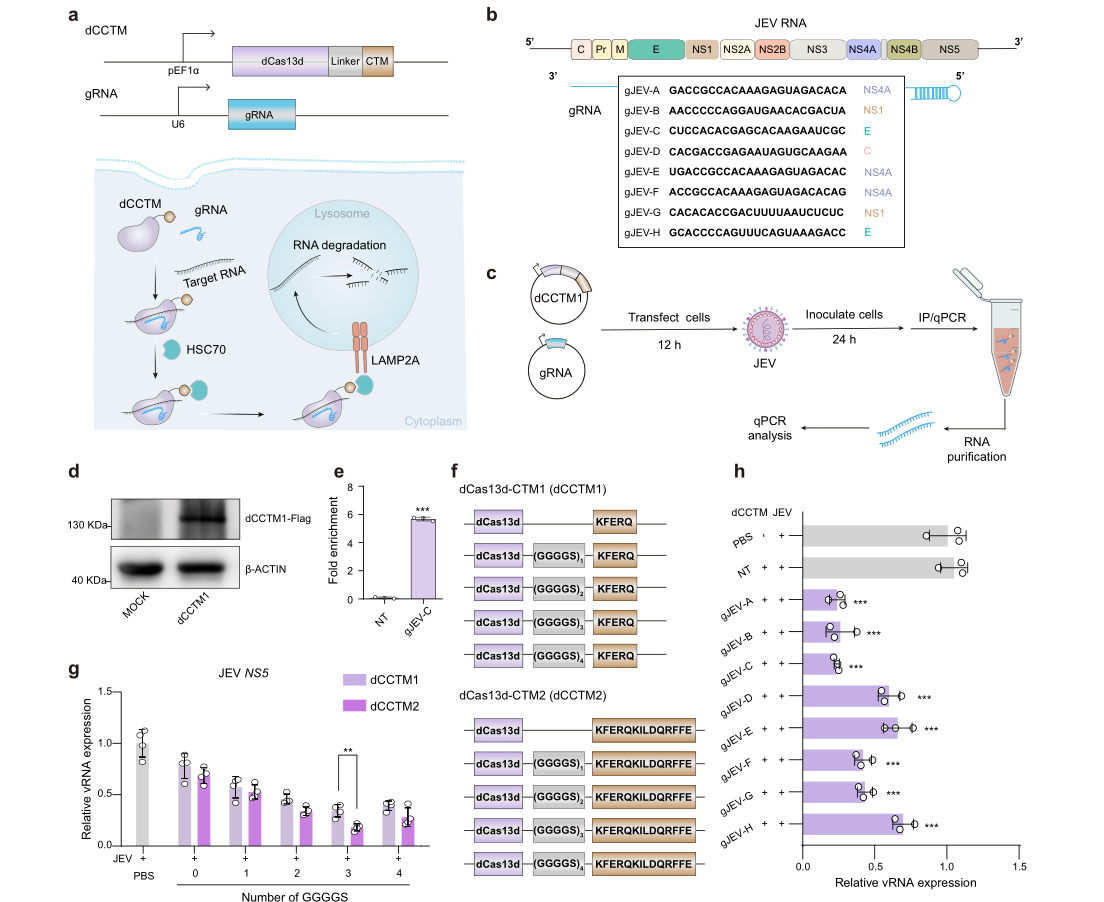
The core design of dCasCMA is remarkably clever. The team first used a **catalytically dead Cas13d **(dCas13d). This “deactivated” Cas13d loses its ability to cut RNA but retains its capacity to bind precisely to a target RNA under the guidance of a guide RNA (gRNA), acting like a precision-guided “anchor.”
Next, they fused a special “shipping label”—a **CMA-targeting motif **(CTM), such as the classic KFERQ or its optimized version KFERQ-KILDQRFFE—to the dCas13d protein. This label serves as a “pass” for the cell’s CMA pathway. Once the dCas13d-gRNA complex anchors onto the target RNA, this “label” is recognized by Heat Shock Cognate 70 (HSC70) in the cytoplasm.
Upon recognition, the entire “dCas13d-target RNA” complex is treated as “recyclable waste” and is precisely delivered through the Lysosome-Associated Membrane Protein 2A (LAMP2A) channel into the lysosome—the cell’s potent “digestive workshop.” Here, the target RNA, along with dCas13d, is completely degraded.
The brilliance of this strategy lies in its complete circumvention of Cas13’s cleavage activity and its associated off-target risks, instead utilizing the cell’s own highly selective CMA pathway to carry out the final “execution,” achieving true “point-and-shoot” precision.
From Viruses to Tumors: Demonstrating dCasCMA’s Broad Applicability
To showcase dCasCMA’s power, the team validated it in multiple disease models.
- Antiviral Application: They used **Japanese Encephalitis Virus **(JEV) as a model. JEV, a single-stranded positive-sense RNA virus, poses a severe threat to the nervous system. Researchers designed gRNAs targeting different regions of the JEV genome. When combined with the dCasCMA system, the results were striking: dCasCMA efficiently and specifically degraded JEV viral RNA (vRNA), significantly reduced viral E protein expression, and dramatically suppressed viral replication both in cells and in mice. Crucially, in an infected mouse model, dCasCMA treatment significantly alleviated brain inflammation and tissue damage, demonstrating strong in vivo therapeutic potential.
- Cancer Immunotherapy: They turned their attention to the immune checkpoint PD-L1. PD-L1, when overexpressed on tumor cells, “paralyzes” T cells, helping tumors evade immune attack. The team designed gRNAs targeting Pd-l1 mRNA, and the dCasCMA system successfully degraded Pd-l1 mRNA in colon cancer cells with efficacy comparable to established siRNA therapy and lasting effects. More importantly, the downregulation of PD-L1 effectively inhibited signaling pathways associated with Epithelial-Mesenchymal Transition (EMT), significantly impairing the migratory ability of tumor cells.
- Multiplexed, Coordinated Attack: To tackle the “cytokine storm” often accompanying viral infections, the researchers designed a **multiplexed gRNA array **(gJZS) capable of simultaneously targeting JEV RNA and the mRNAs of key inflammatory factors ZBP1 and STING. Experiments showed that dCasCMA could degrade all three targets in concert, not only potently suppressing the virus but also significantly reducing levels of multiple pro-inflammatory cytokines (e.g., TNF-α, IL-6) while boosting the anti-inflammatory cytokine IL-10, thereby effectively calming the excessive immune response and protecting host cells.
Beyond Current Technologies: The Unique Advantages of dCasCMA
The dCasCMA platform exhibits several advantages over existing RNA-targeting technologies:
- Unparalleled Specificity & Safety: By not relying on nuclease activity, it fundamentally eliminates the “bystander cleavage” effect. RNA-seq analysis confirmed that dCasCMA has far fewer off-target effects than wild-type Cas13.
- Programmability & Modularity: Simply by changing the gRNA sequence, the system can be easily redirected to any new RNA target. Its two-component design (“dCCTM protein + gRNA”) offers exceptional flexibility and scalability.
- Efficient In Vivo Delivery: The team successfully packaged the dCCTM protein and gRNA into nanoliposomes (NLPs) and achieved effective targeted delivery and therapeutic efficacy in mice via intracerebroventricular injection, demonstrating its clinical translatability.
- Intrinsic Temporal Control: Interestingly, the dCCTM protein itself carries a CMA tag, meaning it is also degraded by the lysosome after completing its mission. This “self-clearance” mechanism endows the system with a predictable pharmacokinetic profile, allowing it to attenuate automatically after exerting its effect, thus avoiding potential long-term risks.
Future Outlook: A Bridge to a New World of RNA Therapeutics
The emergence of dCasCMA opens up an entirely new avenue for RNA-targeted therapy. It ingeniously combines a synthetic biology tool (CRISPR) with an intrinsic cellular physiological pathway (CMA) to create a “smart missile” system that is both precise and safe.
Although still in the preclinical stage, its immense potential in antiviral therapy, cancer immunotherapy, immune modulation, and even treating diseases caused by dysregulated non-coding RNAs (such as the nuclear-enriched lncRNA NEAT1 mentioned in the study) is undeniably promising. With further optimization of delivery technologies and validation across more targets, dCasCMA or its derivatives could become a powerful engine for next-generation RNA drug development, offering new hope for tackling numerous intractable diseases.
