


Beyond the “Cottage Industry”: Open-Source Powerhouse pyFuRNAce Democratizes RNA Origami Design
Introduction: The Promise of RNA and the Pain of Design
On the frontier of biomedicine, RNA has long outgrown its traditional role as a mere “messenger.” From the triumph of mRNA vaccines to the emergence of diverse RNA therapeutics, scientists are now viewing RNA as a programmable “smart material.” Among its most exciting applications is RNA origami—the art of designing RNA sequences that self-assemble into predefined two- or three-dimensional nanostructures. This technology holds immense potential as a next-generation platform for drug delivery, biosensing, and synthetic biology.
However, compared to the booming field of DNA origami, RNA origami has progressed at a slower pace. A core bottleneck has been the lack of user-friendly, integrated design tools. Previously, researchers were forced to juggle between command lines, text editors, and multiple standalone software packages. The entire design process resembled a tedious and error-prone “cottage industry,” severely limiting innovation and accessibility in the field.
Now, this landscape is set for a transformative shift. A study led by Heidelberg University and the Max Planck Institute for Medical Research has unveiled pyFuRNAce, an open-source software that not only consolidates the complex RNA origami workflow into an intuitive graphical interface but also successfully designed and validated the largest co-transcriptional RNA origami structure to date, injecting a powerful catalyst into the entire RNA nanotechnology community.
1. From Fragmented to Integrated: The Birth of pyFuRNAce
Before pyFuRNAce, a typical RNA origami designer’s workflow was arduous: manually writing blueprint files in a text editor, calling command-line tools to generate 3D structures, using another software for sequence optimization, and finally calculating primers by hand. This process was not only time-consuming but also highly inaccessible to newcomers, where a single formatting error could derail the entire project.
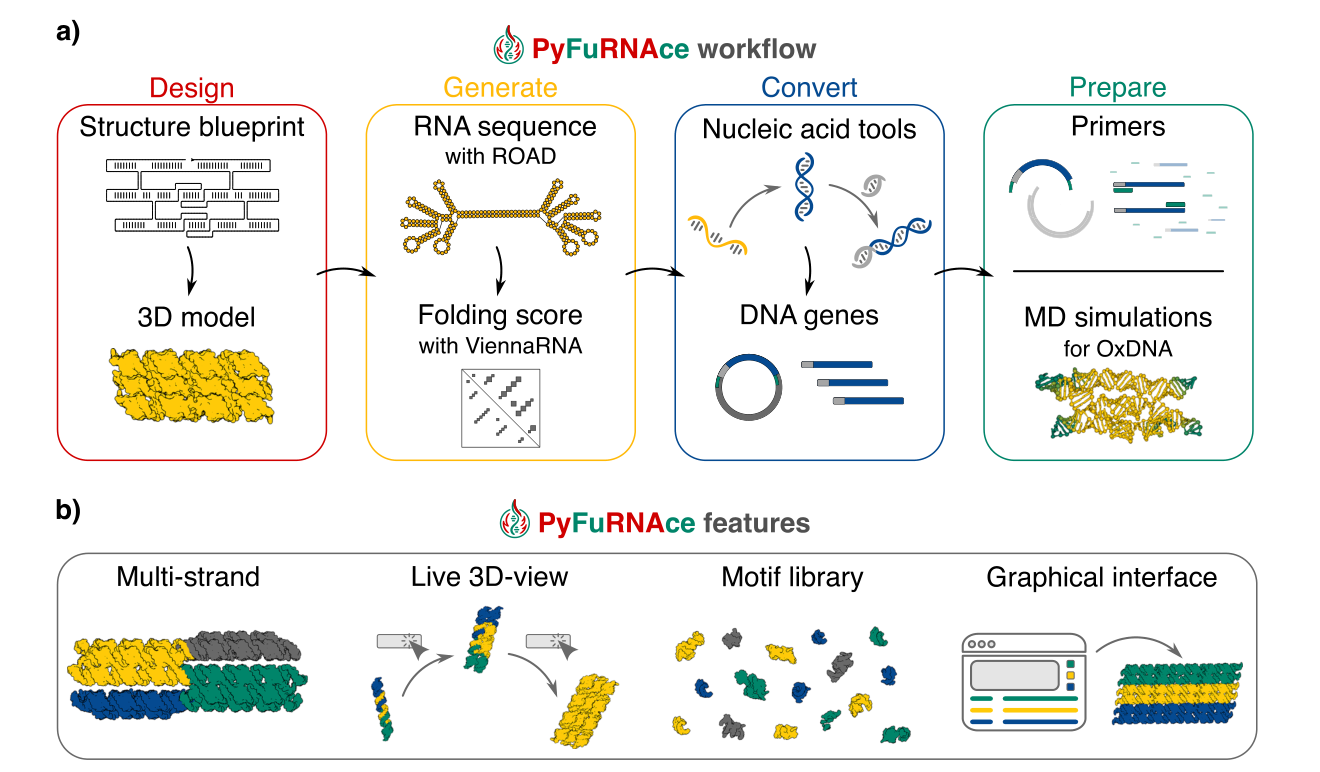
The research team astutely identified this pain point. Building upon the existing ROAD (RNA Origami Automated Design) package, they undertook a complete modernization. The core philosophy of pyFuRNAce is “integration” and “simplification.” It seamlessly unifies all critical steps—from motif definition and blueprint design to 3D visualization, sequence generation, and primer selection—into a single, web-based graphical user interface (GUI).
This means that both seasoned experts and new entrants can now intuitively drag, drop, and assemble various RNA building blocks (motifs) on their screen, with a real-time 3D model of their nanostructure appearing before their eyes. This WYSIWYG (What You See Is What You Get) experience transforms RNA design from an esoteric “craft” into an accessible “engineering” discipline.
2. Four Modules for End-to-End Design
pyFuRNAce’s interface is cleanly divided into four functional modules, covering the entire design pipeline:
- Design: The heart of the software. Users can select from a rich library of built-in motifs (including basic structural elements like helices, tetraloops, and kissing loops, as well as functional aptamers like Broccoli) and place them on a 2D grid. The software automatically aligns and connects these motifs, generating a corresponding 3D model in real-time. Crucially, it supports multi-strand design, enabling the construction of more complex polymeric assemblies.
- Generate: Once the design is complete, a click of the “Generate” button invokes a powerful inverse folding algorithm (Revolvr) to automatically produce an RNA sequence tailored to the target structure. It also leverages the ViennaRNA package to evaluate the folding quality, providing key metrics like energy and ensemble diversity.
- Convert: For in vitro transcription experiments, the RNA sequence must be converted into a DNA template. This module handles this conversion, automatically appends a T7 promoter at the 5’ end, and offers practical utilities like GC content analysis and dimer prediction.
- Prepare: In the final step, the software can automatically calculate and recommend optimal primers based on user-defined PCR conditions, and even prepare input files for subsequent molecular dynamics simulations (using the oxDNA/oxRNA forcefield).
This end-to-end automation frees researchers from tedious technical details, allowing them to focus their energy on creative ideation.
3. Proof of Power: From Filaments to a “Giant” Origami
To validate its capabilities, the team demonstrated pyFuRNAce with three challenging designs:
- Self-assembling RNA Filaments: By engineering specific “kissing loops” at the ends of origami tiles, they successfully guided their co-transcriptional polymerization into micron-scale filaments, confirmed by Atomic Force Microscopy (AFM).
- **RNA Droplets **(Phase-Separated Condensates) Using pyFuRNAce, they designed a three-armed Y-shaped motif with phase-separation-driving sequences at its termini. Confocal microscopy clearly showed the formation of micron-scale, green-fluorescent RNA droplets, offering a new tool for building synthetic organelles.
- The Largest Co-transcriptional RNA Origami to Date: The most striking achievement. The team designed a massive rectangular origami structure composed of 2,501 nucleotides and successfully folded it. AFM images revealed a correct folding yield of over 80%! Previously, the largest reported structure of its kind (2,360 nt) had a near-zero yield. This breakthrough directly proves pyFuRNAce’s exceptional capability in handling ultra-large, complex architectures.
4. Open, Programmable, and Future-Ready
The value of pyFuRNAce extends far beyond its GUI. As a fully open-source (GPL-3.0 licensed) Python project, it lays the foundation for community collaboration and continuous innovation. Users can not only use it for free but also contribute their own motifs or improve the code.
More importantly, it offers a Python scripting API for advanced users. This enables researchers to write scripts for large-scale, high-throughput automated design or integrate pyFuRNAce with other computational tools (e.g., AI prediction models), opening up entirely new research paradigms.
Additionally, the software thoughtfully includes a dot-bracket notation converter, which can instantly transform the common secondary structure representations found in literature into editable origami blueprints, greatly facilitating knowledge transfer and reuse.
Conclusion
The arrival of pyFuRNAce marks the transition of RNA nanotechnology from the “cottage industry” era into an age of “industrialized design.” By lowering technical barriers and enhancing design efficiency and reliability, it is poised to attract a broader community of researchers from synthetic biology, materials science, and medicine into the RNA revolution. True to its name—“Py for RNA ace”—it is not just a powerful tool for experts, but also a friendly gateway for newcomers. As this powerful engine gains widespread adoption, we can expect a surge of sophisticated, functional RNA nanomachines to move from the lab bench to real-world applications, profoundly impacting human health and technological advancement.
