


Beyond Immune Evasion: NSP15 as the Conductor of Viral RNA Recombination
Introduction: When a Virus Starts “Self-Editing”
In the world of viruses, survival is an endless arms race. To thrive under the immense pressure of a host’s immune defenses, viruses have evolved sophisticated strategies. Coronaviruses (CoVs), boasting the largest known RNA genomes among viruses, owe their success not only to rapid mutation but also to a high-level skill called “RNA recombination.” This process allows them to cut and splice their own genetic material like a video editor, generating novel variants for immune escape or environmental adaptation.
However, this “self-editing” game isn't chaotic. A recent groundbreaking study published in Nature Communications (Zhou et al., Nat Commun 2025) has unveiled a key player: a viral “molecular scissors” known as Non-Structural Protein 15 (NSP15). This research not only elucidates how NSP15 acts as a shrewd “traffic cop,” meticulously regulating different pathways of viral RNA recombination, but also reveals a surprising twist: disabling this scissors triggers a self-destructive “friendly fire” immune storm. This discovery offers a fresh perspective on viral pathogenesis and the development of novel antiviral drugs.
1. SARS-CoV-2: A Gifted “Recombination Maestro”
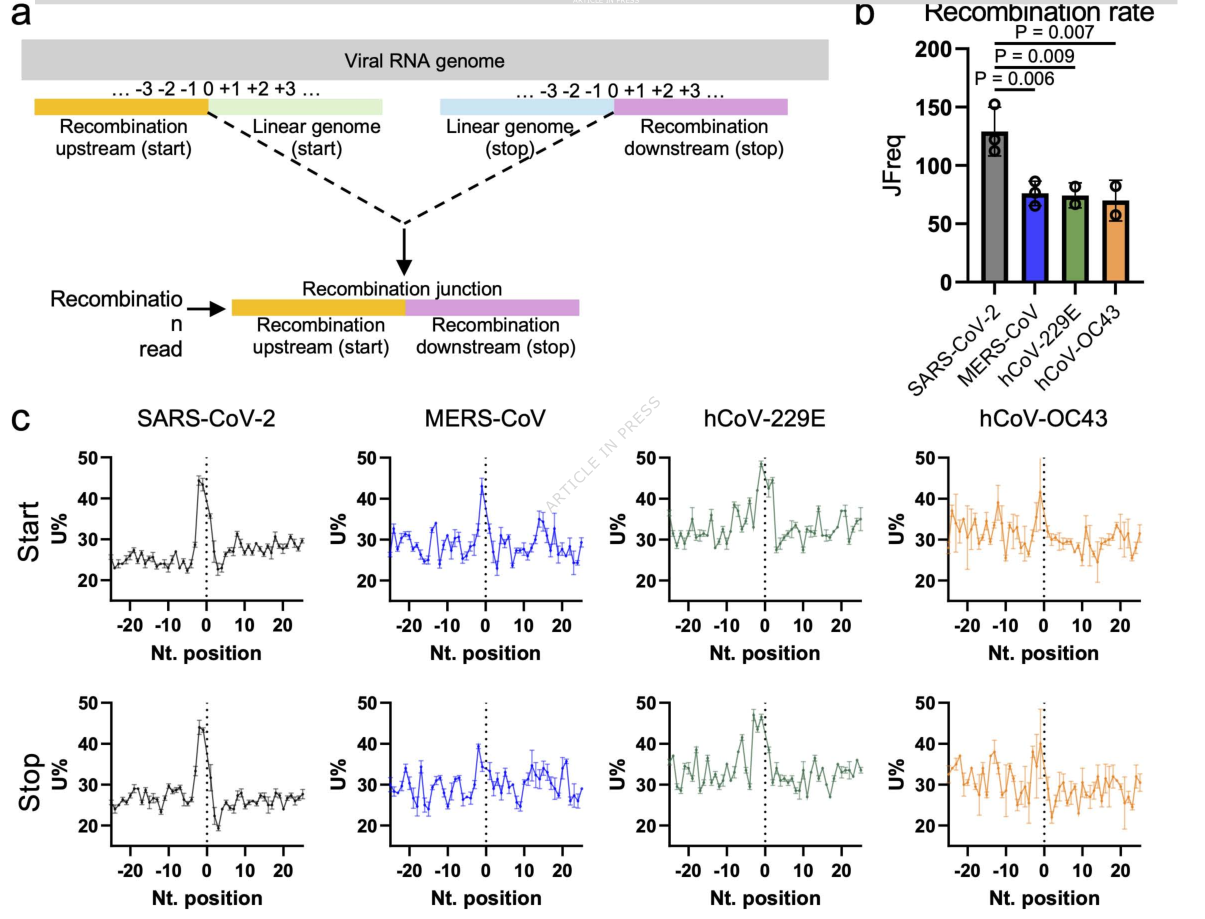
The research team began by conducting deep RNA sequencing analyses on four human coronaviruses (HCoVs), including SARS-CoV-2. The results were striking: SARS-CoV-2 exhibits a significantly higher frequency of RNA recombination compared to other common HCoVs (like the common cold-causing HCoV-OC43 and HCoV-229E, and the deadly MERS-CoV), with its recombination rate nearly 1.8 times higher.
Even more intriguingly, across all these coronaviruses, recombination events showed a strong preference for occurring at uridine (U)-rich RNA sequences. Imagine the viral genome as a long string composed of four letters: A, U, C, and G. The “cut sites” for recombination consistently appear near stretches of consecutive “U” letters. This universal rule strongly implies the existence of a dedicated tool within the virus that recognizes and cuts at these “U” sequences.
That tool is NSP15. As an endoribonuclease (EndoU), NSP15’s function is to precisely cleave RNA strands at uridine residues. Previous studies suggested that NSP15’s primary role was “cleaning up the battlefield”—by degrading aberrant double-stranded RNA (dsRNA) produced during viral replication, it helps the virus evade detection by the host cell’s “sentinels” (pattern recognition receptors like MDA5 and RIG-I), thereby suppressing type I interferon (IFN) production and aiding immune evasion.
2. A Blunted Scissors: Weaker Virus, But No Milder Disease?
To investigate NSP15’s specific role in RNA recombination, the researchers engineered a critical mutant: NSP15-H234A. In this mutant, NSP15’s catalytic activity is completely abolished, effectively blunting the “molecular scissors.”
As expected, in laboratory cell models (especially in the interferon-competent human respiratory cell line Calu-3), the replication capacity of the NSP15-H234A virus was markedly attenuated. When cells were pre-treated with interferon, the mutant virus’s replication was devastated, showing far greater sensitivity than the wild-type virus. This reaffirmed NSP15’s central role in countering the host’s innate immunity.
Yet, the real surprise emerged in live animal experiments. Using the golden Syrian hamster, a well-established model for SARS-CoV-2 infection, researchers infected animals with either the wild-type or the NSP15-H234A mutant virus. The result was puzzling: although the mutant virus showed significantly lower loads in the hamsters’ lungs, the weight loss and clinical disease symptoms in the infected animals were almost identical to those in the wild-type group!
How could a weaker virus cause just as much disease? The answer lay hidden within the host’s immune response.
3. The Double-Edged Sword: From Immune Evasion to an Immune Storm
Deep transcriptomic sequencing of lung tissues from infected hamsters revealed the truth. At the early stage of infection (day 2), lungs infected with the NSP15-H234A mutant exhibited an extremely potent and dysregulated immune response.
On one hand, the loss of NSP15 activity led to an accumulation of immunostimulatory viral RNAs (including dsRNA and Defective Viral Genomes, DVGs). This massively activated the host’s antiviral pathways, causing a dramatic surge in the expression of type I and III interferons (Ifnb1, Ifnl3) and their downstream Interferon-Stimulated Genes (ISGs, such as Rsad2, Mx1, Isg15). This robust antiviral state successfully suppressed viral replication.
But on the other hand, this immune response “overreacted.” Alongside antiviral factors, a flood of pro-inflammatory cytokines (e.g., Cxcl10, Ccl5) and inflammation-related genes (e.g., Tnfaip6, Il1rn) were simultaneously, and even excessively, activated. Pathological examination confirmed that, despite the lower viral load, the lungs of mutant-infected hamsters displayed equally severe immune cell infiltration, bronchiolitis, interstitial pneumonia, and vasculitis as the wild-type group. In essence, while the host’s immune system successfully controlled the virus, it also inflicted severe “collateral damage” on its own tissues.
This perfectly illustrates the double-edged nature of NSP15: it helps the virus evade immune clearance while also preventing the immune response from spiraling out of control. When this sword is blunted, the weakened virus can still maintain its pathogenicity by triggering a violent inflammatory cascade.
4. NSP15: The “Precision Conductor” of RNA Recombination
So, how exactly does NSP15 influence RNA recombination? The study provides a counterintuitive answer. It was previously hypothesized that NSP15’s cleavage activity might provide templates to promote recombination. The opposite is true.
In the NSP15-inactive mutant virus, the overall number of RNA recombination events actually increased! However, this increase was not uniform. The research shows that NSP15 acts as a “precision conductor”:
- Promoting Beneficial Recombination: It positively regulates the generation of **subgenomic mRNAs **(sgmRNAs), which are crucial for the coronavirus life cycle. sgmRNAs are the messengers the virus uses to efficiently translate its structural proteins (like Spike and Nucleocapsid). The NSP15-H234A mutant showed a significant reduction in sgmRNA production, directly explaining its attenuated replication.
- Suppressing Harmful Recombination: It negatively regulates recombination events that lead to **Defective Viral Genomes **(DVGs), such as large deletions and micro-deletions. In the mutant, these erroneous recombination events surged, producing more highly immunostimulatory DVGs—the very “kindling” that ignited the immune storm.
This phenomenon was clear in both cultured cells and purified virions. In vivo, the picture was more complex. Due to the host’s strong selective pressure, while the diversity of DVGs from the mutant virus decreased, certain specific DVGs that might confer a fitness advantage were strongly selected for and became dominant in the viral population.
5. Implications and Outlook: Opportunities and Challenges in Targeting NSP15
The implications of this study are profound. First, it may explain why SARS-CoV-2 is more evolutionarily potent than other coronaviruses—its unique NSP15 activity might have struck an optimal balance between promoting sgmRNA production and suppressing DVGs, ensuring efficient replication while maintaining sufficient genetic diversity to face selective pressures.
Second, for drug development, NSP15 is undoubtedly a highly attractive target. Inhibiting its activity can weaken viral replication and boost the host’s antiviral immunity. However, this study also sounds a cautionary note: Blindly inhibiting NSP15 could trigger excessive inflammation, leading to tissue damage disproportionate to the viral load, which could be clinically dangerous.
Therefore, future drug design needs to be more nuanced. The ideal scenario would be to develop compounds that can specifically block NSP15’s immune evasion function without disrupting its role in sgmRNA regulation; or, to combine an NSP15 inhibitor with appropriate anti-inflammatory therapy to balance the immune response.
In conclusion, this research redefines NSP15 from a mere “immune evader” to a “central coordinator” in the viral life cycle and the host-virus interaction network. It profoundly reminds us that in our fight against viruses, we must not only focus on how to kill the virus but also understand the delicate and complex interplay between the virus and our own immune system. Only then can we develop truly safe and effective next-generation antiviral therapies.
