


Giving mRNA a "Longevity Engine": Scientists Unlock RNA Stability Secrets from Viruses

Introduction: The Challenge of mRNA Stability
mRNA technology has revolutionized the development of vaccines and therapeutics. However, the limited stability of mRNA in vivo remains a major hurdle. While alternative formats such as circular RNA (circRNA) and self-amplifying RNA (saRNA) offer greater durability, they often suffer from low translation efficiency, incompatibility with base modifications, and complex manufacturing.
To address these limitations, a team led by V. Narry Kim at Seoul National University conducted a systematic screen of nearly 200,000 viral sequences to identify RNA stability enhancers that significantly boost mRNA stability and translation. Their findings, published in Nature Biotechnology, reveal a mechanism centered on TENT4-mediated mixed tailing, offering a robust solution for durable mRNA therapeutics.
1. Background: The Central Role of Poly(A) Tail Integrity
In the canonical mRNA decay pathway, the rate-limiting step is deadenylation—the gradual shortening of the poly(A) tail by the CCR4–NOT complex. Once the tail falls below a critical length, the mRNA is degraded. The poly(A) tail also plays a key role in translation initiation by interacting with PABPC.
Viruses have evolved RNA motifs that recruit TENT4 enzymes, which add non-adenosine residues to the poly(A) tail, forming a “mixed tail” that resists deadenylation and enhances mRNA stability.

2. Study Design: A Systematic Viral Screen
The researchers constructed a library of 196,277 viral genomic segments from 337 viral species spanning 297 genera. A two-step screening strategy was employed:
-
Primary screen: Viral fragments were inserted into the 3′UTR of an EGFP reporter, integrated into HEK293T cells, and sorted based on fluorescence intensity.
-
Secondary screen: Enriched fragments were cloned into a luciferase reporter, synthesized as m1Ψ-modified mRNA, transfected into HCT116 cells, and assessed for RNA stability by sequencing.
From 10,784 enriched tiles, 131 significantly enhanced the stability of m1Ψ-modified mRNA, leading to the validation of 11 core elements (A1–A11).
3. Key Finding: A7 Emerges as a Standout Performer
Among the 11 validated elements, A7 (derived from Melegrivirus A) demonstrated exceptional properties:
-
Broad modification compatibility: Functional with m1Ψ and m5C;
-
Cross-cell-type activity: Effective in hepatocytes, lung epithelial cells, T cells, and more;
-
Unique mechanism: Lacks the CNGG motif and operates independently of ZCCHC14;
-
Well-defined structure: Deep mutagenesis identified critical regions—an internal loop (IL) and stem-loop SL2.
4. Mechanism: TENT4-Dependent Mixed Tailing
Most viral elements (except A7) contain a CNGG loop motif that recruits TENT4 via the adaptor protein ZCCHC14, leading to poly(A) tail extension with mixed nucleotides.
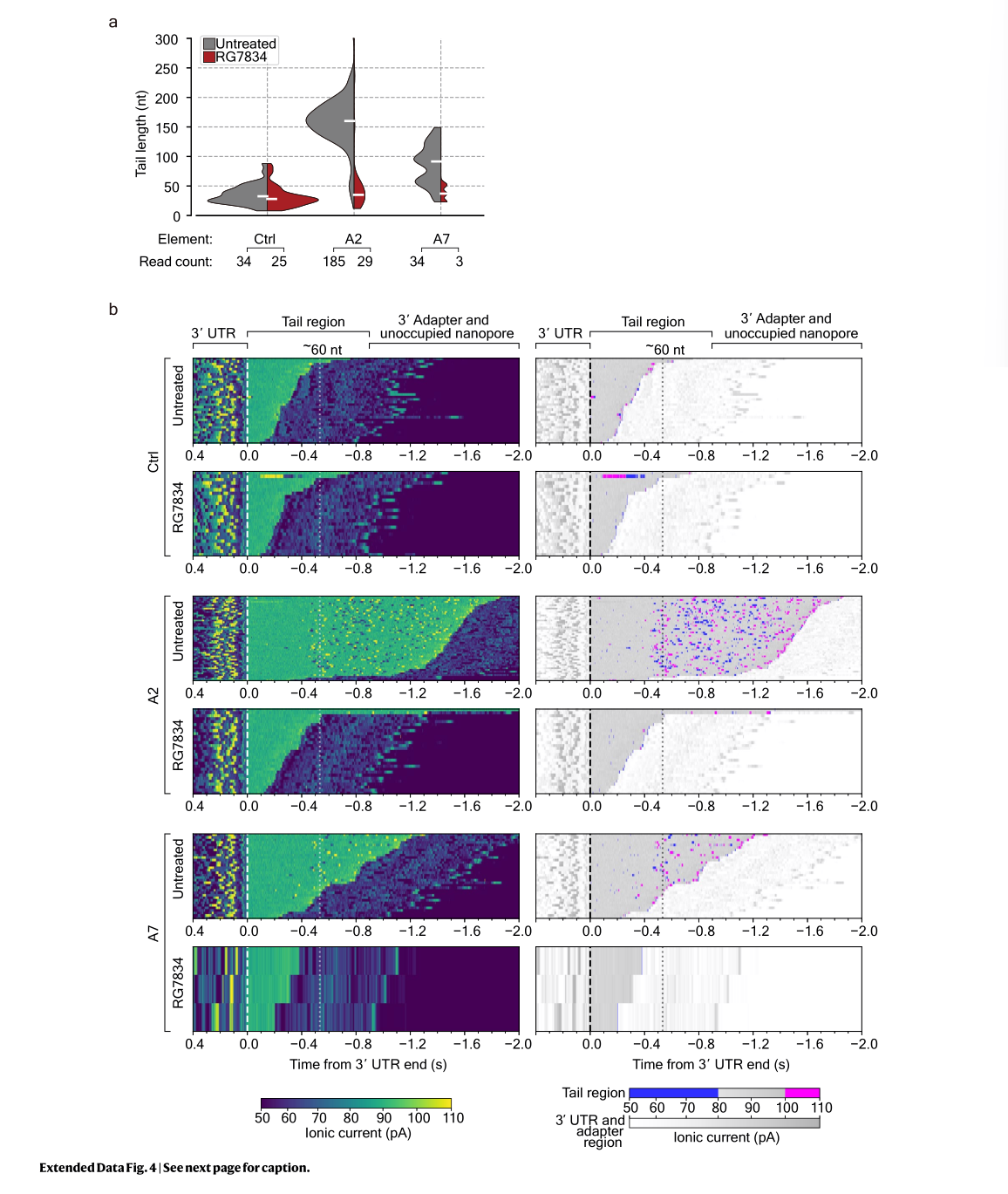
A7, despite lacking the CNGG motif, also depends on TENT4, suggesting the involvement of an unknown adapter protein. Nanopore direct RNA sequencing confirmed that A7 and A2 extend poly(A) tails in a TENT4-dependent manner.
5. Performance: A7-Linear mRNA Rivals circRNA
The team compared A7-containing linear mRNA with optimized circRNA:
-
Half-life: A7-linear mRNA showed a half-life comparable to circRNA (~15–19 hours) in HepG2 and HCT116 cells;
-
Protein output: A7 mRNA outperformed circRNA at all time points, with a 5–6 fold increase in total protein production;
-
In vivo persistence: In mouse liver, A7 mRNA sustained luciferase expression for over 13 days, surpassing circRNA.
6. Therapeutic Potential: From Bench to Bedside
These viral RNA stability enhancers, especially A7, hold broad therapeutic promise:
-
Applications: Protein replacement, cancer immunotherapy, gene editing, tissue reprogramming;
-
Cell-type specificity: A2 works well in monocytes, A7 in hepatocytes and T cells;
-
Manufacturing advantage: Linear mRNA is simpler and cheaper to produce at scale;
-
Safety: Avoids immunogenic dsRNA intermediates associated with saRNA.
7. Conclusion and Outlook
This study identifies a set of viral RNA elements that dramatically enhance the stability and translation of base-modified mRNA. A7, in particular, enables linear mRNA to achieve circRNA-like stability with superior translation efficiency, offering a versatile and powerful platform for next-generation mRNA therapeutics.
Looking ahead, A7 and its derivatives are poised to become essential tools in gene therapy, vaccine development, and precision medicine, ushering in a new era of durable and efficient mRNA-based treatments.
